I’m 36 years old, and I’ve always been an active person. Growing up, I played a lot of football and pretty much every ball sport I could get involved in. As I got older, that energy somehow developed into looking for slightly different kinds of challenges. I’ve run a marathon, completed Vasaloppet, 90 kilometres on cross-country skis in minus 26 degrees over roughly ten hours, cycled to Hamburg by myself, done HYROX Pro and probably a few other things that the average person wouldn’t necessarily wake up one morning and decide were a good idea.
I’ve thought quite a lot about why I keep doing these things. For me, it’s about putting something in front of myself that I don’t completely know if I can do. Setting a goal, working towards it and, especially as I’ve got older, becoming mentally stronger along the way.
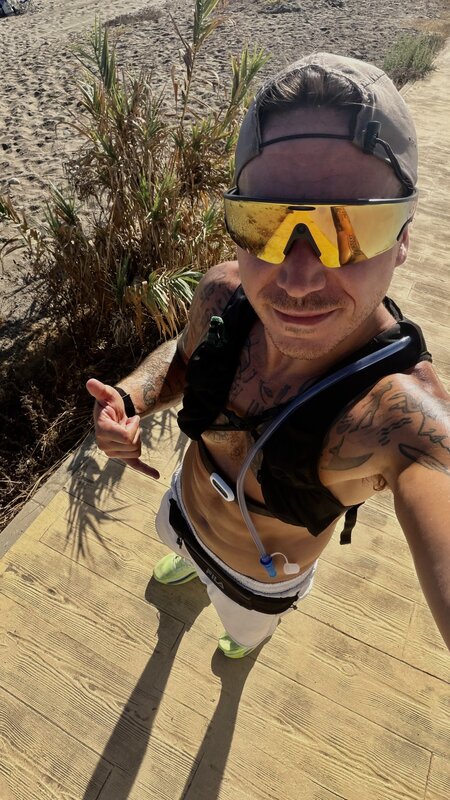
On a later attempt, I tried to run faster but had to stop at around 27 kilometres when my right knee stopped cooperating.
Spain, and the Moment the Project Began
We’ve now been living in Estepona for around a year, and I can comfortably say it’s one of the best decisions I’ve ever made. The first six months, however, were probably a little too enjoyable. Restaurants, good food, a few drinks, sunshine and finally living somewhere we had talked about for years. Add the amount I travel for work and eventually it starts feeling like you’ve been on holiday for slightly too long.
Whenever I reach that point, I start asking myself what actually needs to change. This time I didn’t have to look very far, because the answer was literally standing in front of me. All around Estepona I started seeing signs for the Official Estepona Marathon, October 11, 2026. My family has a name for these moments. They call them my “fix ideas”. I had twelve weeks, and I was going to run a marathon.
We left somewhere that no longer really felt like home and went looking for something new, to see what was behind the next mountain.
Estepona, August 2026The scale was the least reliable narrator in the whole project.
| Morning | Weight | Note |
|---|---|---|
| 29 July | 95.0 kg | the first morning in the log |
| 22 August | 92.0 kg | after three mornings of gain, in my hardest week |
| 29 August | 89.5 kg | the lowest morning in the series |
Twenty-four mornings were recorded, and the three above are the ones that matter. In between, the number went up three days running from 19 to 22 August, the week of an 18 km run in heat and a 21 km run on low carbohydrate, and then fell 1.3 kg in the single night after that 21 km. No measurements exist for 9 to 14, 26 and 28 August.
- the distance
- 42.195 km
- weeks of training
- 12
- race day
- 11 Oct
- no beer since
- end of June
- weight at the start
- 95.0 kg
Removing the Excuses Before They Exist
Naturally, once I had decided I was running a marathon, the next step was to drive to the nearest shopping centre and make sure I had absolutely no excuses left. New shoes, proper running clothes, a hydration vest, bottles, gels, electrolytes, the whole thing. And because I’m apparently incapable of starting a new project without adding some technology to it, I obviously came home with a pair of Oakley Meta glasses as well.
There is actually some logic behind all of this. I never want to reach week eight and start searching for excuses. I would rather buy my way out of those excuses at the beginning. Once that’s done, there’s nowhere to hide. Then it’s just you and the work.
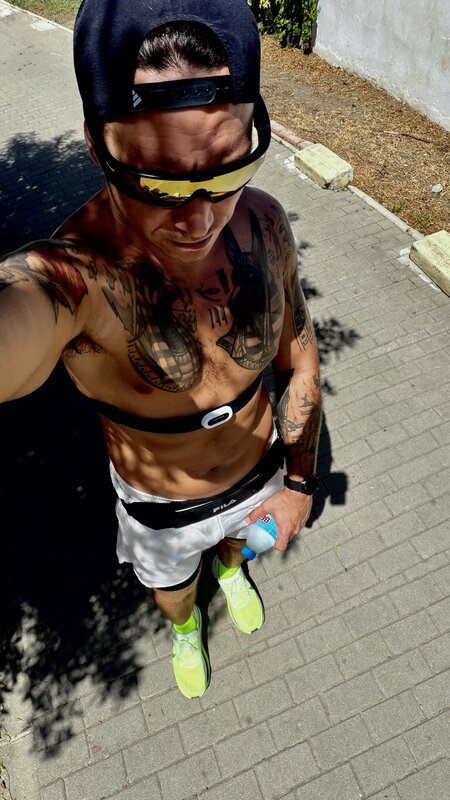
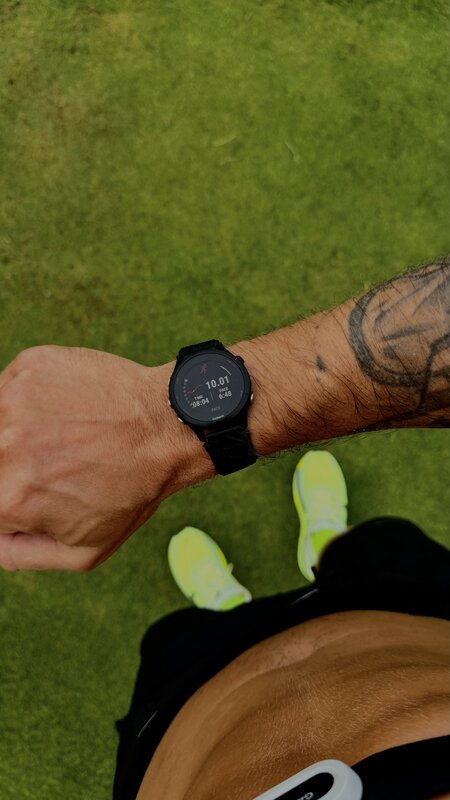
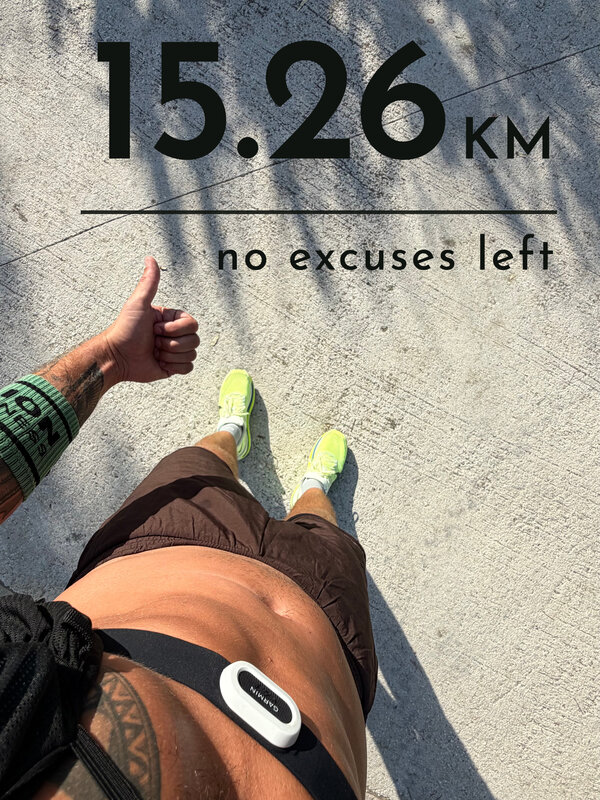
Everything bought in one trip, so that week eight would have nothing left to argue with.
Early August 2026A Plan Built Around the Person Doing It
The next question was how I was going to structure twelve weeks of marathon training. I considered using a coach, but I’ve gone pretty deep into different AI tools over the last couple of years, and using AI to build the programme felt like a natural experiment. Over time, it became less about asking for a generic marathon programme and more about building something specifically around me.
My instruction from the beginning was simple. I want to finish this marathon without pain. That requires something I haven’t always been particularly good at. Patience.
Five written plans in five weeks, and every rewrite was caused by something that actually happened.
- 28 JulyThe first roadmapWritten before a single session had been recorded.Long runs climbing 14, 16, 18 and on to 32 km before tapering
- 28 JulyA four-week blockWritten the same day as the roadmap.The same ambition laid out day by day: intervals, aerobic volume, strength, one long run
- 29 JulyMonth one cut backThe first documented run showed heavy legs.The opening month reduced the day after it was written
- 17–23 AugustA week written from dataBy mid-August the schedule was moving with heat, sleep, travel and soreness.Weekly target 42–46 km, long run 19–20 km, first 5 km deliberately easy
- 24–30 AugustThe track editionWritten around childcare and access to the sports facility where my children train.Weekly target 47–50 km, sessions moved to the track
The useful part is not to copy the plan but to start with a structure and adapt it to the athlete who actually shows up. Planned sessions and completed sessions are kept separate throughout.
The intervals did not get faster. They got longer at the same pace.
| Session | Repetitions | Total | Pace per km |
|---|---|---|---|
| 6 August · 34°C | 5 × 1 km | 5 km | 5:09–5:33 |
| 20 August | 5 × 1.5 km | 7.5 km | 5:29–5:45 |
| 26 August | 3 × 2 km | 6 km | 5:22–5:33 |
On 6 August I ran five repetitions of one kilometre between 5:09 and 5:33 per kilometre, in 34 degrees. On 20 August, five of one and a half kilometres between 5:29 and 5:45. On 26 August, three of two kilometres between 5:22 and 5:33. The pace held while the distance I held it for doubled.
Patience
I’ve done enough endurance events by now to know that, for me, these things aren’t really about whether my body can suffer. I know it can. The more interesting battle is mental. Can I follow a twelve-week plan without constantly trying to accelerate it? Can I accept that today’s run is supposed to be slow even when I feel like going faster?
The long run grew from 12 to 30 kilometres over six runs.
Long runs went 12.11 km on 2 August, 15.26 km on 9 August, 18.02 km on 16 August, 21.01 km on 22 August, 25.01 km on 30 August, when the planned 22 km were extended by 3.01, and 30.01 km on 13 September.
When you’ve been running for a long time, your head eventually starts talking to you. Maybe slow down. Maybe stop for a minute. Maybe you’ve already done enough. If I start thinking that I don’t want to do today’s session, I change the perspective. Do I want to finish the marathon? Yes. Then this session is part of finishing the marathon.
A month later I ran 29 seconds faster per kilometre, at almost the same heart rate.
- Average heart rate
- 133 → 132 bpm
- Pace, one month later
- 7:03 → 6:34 per km
On 29 July the pace was 7:03/km at an average of 133 bpm; on 27 August it was 6:34/km at 132 bpm, 29 seconds per kilometre faster at essentially the same heart rate. These are two runs out of seventeen, chosen because their heart rates match; this is that one comparison, not a measurement of steady improvement.
Four Weeks Down
I’ve now passed four weeks and I’m into week five, and I can already feel the difference. There’s something incredibly simple about leaving the office, putting my shoes on and heading down towards the beach. From my desk, it takes me around ten minutes before I’m standing on the promenade with the Mediterranean next to me.
The weekly load rose in steps, with a lighter week in the middle, from 30 to 51 kilometres.
| Week | Distance | Runs | Change |
|---|---|---|---|
| week of 27 Jul · part week | 30 km | 3 runs | — |
| week of 3 Aug | 46 km | 4 runs | +16 km |
| week of 10 Auglighter week | 35 km | 3 runs | −11 km |
| week of 17 Aug | 41 km | 3 runs | +6 km |
| week of 24 Aug | 51 km | 4 runs | +10 km |
Kilometres run per calendar week from my own log: 30, 46, 35, 41 and 51. The first row covers only the five days from 29 July, when the log begins. Strength sessions, walks and mobility work are not in the log, so this is how much I ran, not everything I did.

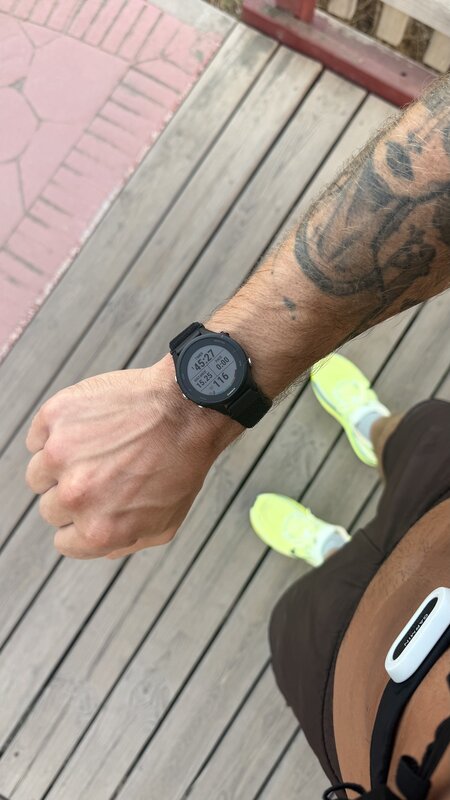
Ten minutes from the desk to the promenade, and the sea does the rest.
August 2026Yes, training for a marathon during a Spanish summer can be slightly warm, but choose the right time of day and it’s pure motivation. The sea, the promenade, the mountains in the background and the fact that all of it is ten minutes from my office makes it very difficult to complain.
Seventeen runs in thirty-three days, and I never took more than two days off in a row.
- Monday 2026-07-27: outside the log
- Tuesday 2026-07-28: outside the log
- Wednesday 2026-07-29: ran
- Thursday 2026-07-30: no run logged
- Friday 2026-07-31: ran
- Saturday 2026-08-01: no run logged
- Sunday 2026-08-02: ran
- Monday 2026-08-03: no run logged
- Tuesday 2026-08-04: ran
- Wednesday 2026-08-05: no run logged
- Thursday 2026-08-06: ran
- Friday 2026-08-07: no run logged
- Saturday 2026-08-08: ran
- Sunday 2026-08-09: ran
- Monday 2026-08-10: no run logged
- Tuesday 2026-08-11: ran
- Wednesday 2026-08-12: no run logged
- Thursday 2026-08-13: no run logged
- Friday 2026-08-14: ran
- Saturday 2026-08-15: no run logged
- Sunday 2026-08-16: ran
- Monday 2026-08-17: no run logged
- Tuesday 2026-08-18: ran
- Wednesday 2026-08-19: no run logged
- Thursday 2026-08-20: ran
- Friday 2026-08-21: no run logged
- Saturday 2026-08-22: ran
- Sunday 2026-08-23: no run logged
- Monday 2026-08-24: ran
- Tuesday 2026-08-25: no run logged
- Wednesday 2026-08-26: ran
- Thursday 2026-08-27: ran
- Friday 2026-08-28: no run logged
- Saturday 2026-08-29: no run logged
- Sunday 2026-08-30: ran
- runs
- 17
- over 33 days
- longest break
- 2 days
- and only twice
- one rest day
- 12 ×
- the usual rhythm
- two days in a row
- 2 ×
- the exception
Every run in my log between 29 July and 30 August. The log holds runs only — strength work, walks and mobility are not in it, so a day without a run is not a day without work.
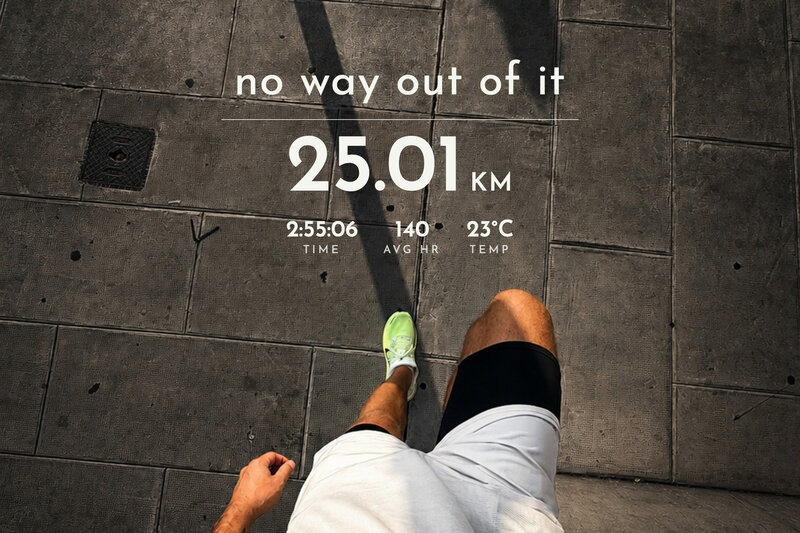
- on 30 August
- 25.01 km
- time
- 2:55:06
- average heart rate
- 140 bpm
- temperature
- 23°C
- calories
- 2 037
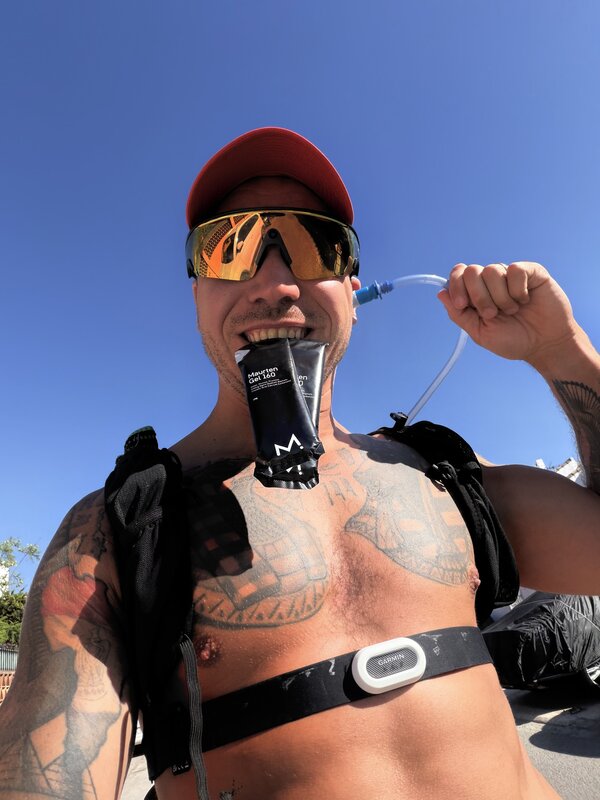
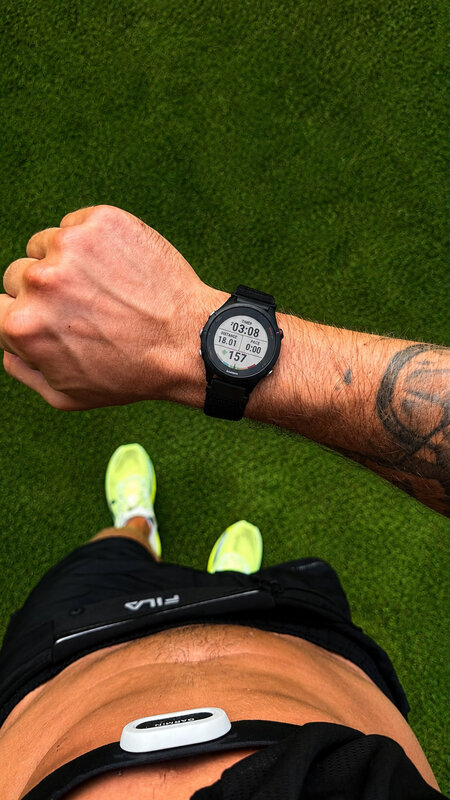
The 25 km run started like any other morning, with a gel and the hose over the shoulder.
30 August 2026- carbohydrate per hour
- 30–45 g
- first gel at
- 35–40 min
- then every
- 30–35 min
- one gel, roughly
- 23 g
The same five kilometres took me three minutes less at the end than at the start.
- The same five kilometres
- 37:04 → 33:51 first / last
- First and last kilometre
- 8:02 → 6:39 per km
On the 30 August run the first five kilometres took 37:04 and the last five took 33:51, the same distance 3:14 quicker. The first kilometre was 8:02 and the last was 6:39, the quickest full kilometre the watch recorded. Kilometres 12 to 15 were not recorded, so the quickest kilometre of the whole run cannot be named; I ran all 25.01 km.
Latest Training Update, 9 to 13 September
The last three sessions marked a significant step forward in the marathon build.
The long run reached 30 kilometres, four weeks before the race.
| Session | Distance | Time | Pace per km |
|---|---|---|---|
| 9 September · intervals | 14.01 km | — | 6:02 |
| 11 September · easy run | 9.28 km | 1:00 h | 6:28 |
| 13 September · long runlongest of the build | 30.01 km | 3:22 h | 6:45 |
On 9 September a quality session of about 16 km in total, a 2 km warm-up, then 4 × 2.5 km intervals with 500 m easy recovery, then a cool-down. The recorded 14.01 km averaged 6:02 per kilometre, with the fastest full kilometre at 5:13. On 11 September an easy 9.28 km in one hour, controlled aerobic running between the two key sessions. On 13 September 30.01 km in 3 hours 22 minutes, the longest run of the build so far, which extends the long-run progression to roughly 12, 15, 18, 21, 25 and 30 km.
After the 30 km run I was very fatigued and physically beaten up, with some feeling that an illness may also be developing. Training will therefore be recovery-led for the next few days rather than trying to force the schedule.
The Race Is Still Ahead
I still have less than four weeks of training before I stand on the start line here in Estepona. Obviously I want to finish the race, but I already know that the most important part of this project is happening now. It’s going out when something else would be easier, running slowly when I want to go faster, and proving to myself again that when I decide to change direction, I can.
One of my reasons is very simple. I have two children who are getting bigger, faster and stronger every year, and I intend to be their best opponent for as long as I possibly can. If they want to beat Dad, they’re going to have to work for it.